
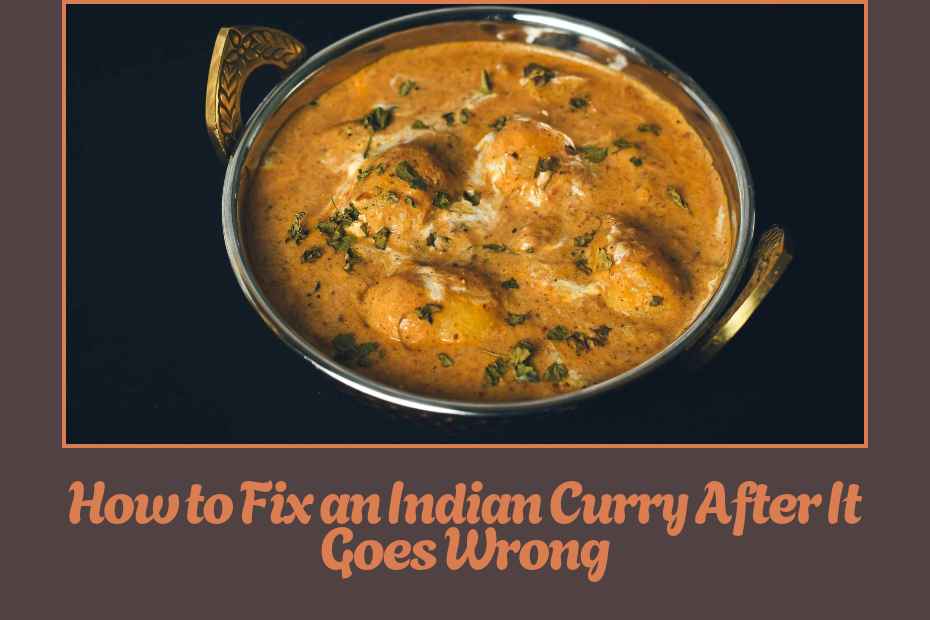
A Indian curry is one of the things that are perfect in the pan and all wrong on the palate. Maybe you added too much chilli powder, the gravy was too liquid, or the tomatoes were too sour and the masala was on the bottom of the pan and it was bitter.
The good thing about this is that majority of the Indian Curry errors are corrected without necessarily throwing the entire dish away.
The trick is to know what has caused the problem and put in a certain amount more. Adding cream to all of the bad curries, e.g. will make a Indian curry already thick greasy. Watering a salty curry will make the salt dissolvable, but may also cause all the other flavors to be thinned.
This manual is a clarification on how to salvage an Indian curry that has gone astray with 15 prevalent curry issues and the useful suggestions on how to recover the intended balance.
Quick Indian Curry Troubleshooting Table
| Curry Problem | Common Cause | Best First Fix |
|---|---|---|
| Too spicy | Too much chilli | Stir in dairy or coconut milk or additional curry grounds. |
| Too salty | Excess salt (or foods high in salt). | Basiccurry. Add additional unsalted curry base. |
| Too sour | Excessive tomato, tamarind or lemon. | Enrich with flavor and a touch of sweetness. |
| Too bitter | Rasted spices or spices bitter. | Rebalance and transfer pan. |
| Too watery | Excess liquid | Simmer uncovered |
| Too thick | Over-reduction | Gradually pour in hot water, or un-salted stock. |
| Too oily | Oil or fat that is not trapped. | Skim excess oil |
| Too bland | Masala: Immature or badly seasoned. | Add spices and acidity, salt and final aromatics. |
| Raw spice taste | Spices that were not cooked. | Bake a few minutes. |
| Burnt taste | Pan masala in pan. | Immediately pour into a clean pan. |
| Too sweet | Sugar or sweeteners in excess amounts. | Add savory, salt, and acidness. |
| Excess garam masala. | Heavy finishing spice | Dilute with more curry base |
| Curdled gravy | To dairy add maximum heat. | Cool down and sand. |
| Taste of onions is overwhelming. | Onions insufficiently cooked | Keep on cooking the base. |
| Flavor feels flat | Poorly balanced or odored. | Serve with a topping of acid, herbs or fresh tadka. |
Clean – Indian Curry is too spicy

The commonest errors made with curries are probable to be the addition of excessive amounts of chilli.
Do not just think of pouring a lot of water in. It is filled by water which ordinarily leaves it a thin, spicy curry as opposed to a well balanced one.
How to Fix It
Precautions in making smooth curries are first to add ingredients in the sequence; they are:
- Plain yogurt
- Cream
- Coconut milk
- Cashew paste
By using a small amount of unsalted, chilli-free base curry, to make curries using tomatoes or onions in place of the original base curry simply add it to the original.
Paneer, paneer as well as potatoes, vegetables, chickpeas, lentils or other meat can also be used to bulk up the dish, and sprinkle the combination with chilli instead.
The precious word slowly is it. Add a little, simmers, taste and repeat where required.
2. Indian Curry Is Too Salty
Removing salt than adding it is more challenging.
The best approach is, therefore, dilution with the use of the ingredients that do not have any additional salt.
How to Fix It
Take a little of the bottom of the original base of the Indian Curry with no salt, and add it to the salty curry.
This can involve incorporation of:
- Unsalted onion-tomato masala
- Cooked lentils
- Chickpeas
- Vegetables
- Coconut milk
- Cream
- Unsalted stock/water.
It cannot be relied upon to the general belief, that even in a Indian Curry that a single potato will ever draw out too much salt. Being able to boost the overall quantity of food that has not been salted is much more predictable.
3. Indian Curry Is Too Sour
A acidic touch can be imparted by tomatoes, yogurt, lemon juice, amchur and tamarind. Using a number of acidic ingredients simultaneously can result in the unpleasant sharpness of the curry.
How to Fix It
Firstly, add curry, and allow it to stew a bit more, in case the sourness is occasioned by tomatoes.
It is now time to introduce an opposing factor to the dish that might be cream, coconut milk, cashew paste or more cooked base of onion.
A pinch of sugar will just neutralize excessive acidity, rather than make sugar the main solution. Divide it into bits and test.
4. Indian Curry Tastes Bitter
Burnt garlic, burnt onions, scalded powdered spices, an overload of fenugreek, overcooked whole spices or a blazed masala base may result in bitterness.
How to Fix It
- So long as there is something that can be burnt at the bottom of the pan then stop stirring.
- Pour the top of the curry to another clean pan leaving the burnt layer at the bottom.
- Savor the saved curry.
A slight level of bitterness is sometimes offset by a higher percentage of curry base, fat and an incredibly small amount of sweetness. The burnt bitter tastes are more difficult to heal as the burnt substances have already permeated the sauce.
5. Indian Curry Is Watery
When a lot of water is added or when vegetables lose their water when cooking, a watery curry usually occurs.
Luckily, this is among the simplest issues to rectify.
How to Fix It
- Take off the lid and boil the curry.
- The gravy thickens as the water evaporates and the flavours are enhanced.
- You can also thicken the curry with: depending on the curry:
- Onion-tomato masala
- Cashew paste
- Cooked lentils
- Mashed chickpeas
- Coconut paste
Add no flour- they are not necessary. When it is not found in the original on the basis of the recipe, it is capable of altering the texture and taste of an Indian curry.
6. Indian Curry Is Too Thick
Long simmering, refrigeration or warming can result in a curry becoming too thick.
Add a bit of hot water, unsalted stock or coconut milk or any other liquid of your choice.
Combine well and leave until further added.
To make an already too thick curry, half a cup may suffice to thin it. The power is far more so when the same is applied little by little.
7. Indian Curry Is Too Oily
Some oil separation is the norm with ingredients of most Indian dishes, and could indicate that an Indian masala has been cooked nearly. The matter begins with a discernible portion of oil making the plate accordingly greasy.
How to Fix It
Let curry sit to ensure that it drains off to the top. With a spoon take some away carefully.
Did the curry happen to be oil-based and very spiced then it can be served in that case as well adding more of the gravy base.
Next batches When cooking aromatics and spices, it is important to ensure that there is enough fat to cook the products and not to add more fat and hope to be able to extract more flavor.
8. Indian Curry Tastes Bland
A curry broth need not necessarily need more chilli added.
The success of the Indian curry is dictated by a number of ingredients, including salt, aromatics, spices, acidity, fat, browsing and finishing.
How to Fix It
- Savour the curry.
- Ask yourself:
- Does it need salt? Even a little can enliven current flavors significantly.
- Is it acid-free? Ready curry may be brightened up by a spoonful of lemon juice.
- Does it need aroma? A teaspoon of fresh coriander, ground kasuri methi or sprinkle of tadka will suffice.
- Did the spices go out by cooking? It may be enriched too with more raw spice powder after the spice.
Instead of placing all the spices in your cupboard and throwing them together, add the missing ingredient.
9. Indian Curry Has the Taste of Spice and is RAW.
The masala normally requires time to cook with ground turmeric, coriander, cumin and chilli powders.
They may also be introduced afterward or cooking part is in a hurry, in both cases, you will discover their taste dusty or acrid.
How to Fix It
- Continue cooking the curry on a low burner to enable the spices to diffuse.
- As the gravy is drying, add a drop of water so as to prevent gravy that burns up.
The second thing to remember the next time we will put powdered spices to your masala is that, you have to cook the spices on controlled heat, and not add large quantity of water to them.
10. Indian Curry Tastes Burnt
- Scalded curry should be rapid.
- Heat-off Do not scrape bottom.
- Squeeze out the curry so far not affected to another saucepan. There should be no removal of the blackened material that is fixed on the original pan.
- As you only had a small amount of curry burnt, you might allow the rescued back the fresh gravy.
When the pinna of the curry smells of burnt odour so much, though, it is quite impossible, even by the addition of sugar, cream or spices, to conceal the odour completely.
It is not always the case that the best remedy to intense burning is to re-commence instead of wasting a lot of ingredients trying to fix the burning problem.
11. Indian Curry Is Too Sweet.
Sugar is sometimes related to the sweetening of the sour, but too much sugar can make a curry that was originally savoury turn an alarmingly sweet.
Caramelized onions, coconut milk or some vegetables may also be sweet and hence a natural source of sweetness.
How to Fix It
Trial some acid to the food, such as:
- Lemon juice
- Tomato
- Tamarind
- Measured salt level. It may be diluted in the process of proper seasoning so as to do away with the impression that it is over-sweet.
Do not overdo with a lot of lemon juice. You can even replace the sweet curry dilemma with sour one.
12. Overboard Garam Masala
Garam masala is usually potent especially when preparing a finishing spice.
The abundance will overwhelm the entire curry with the clove, cinnamon, cardamom and other aromas of spicy warmth.
How to Fix It
Dilution works best.
Add additional main gravy, but without adding additional garam masala. The quantity of tomato-onion base, lentils, vegetables, coconut milk or any other appropriate ingredient, according to the recipe, is to be added.
Allow all to simmer then retest.
13. Curry Gravy Has Curdled
The yogurt and some of the dairy based sauces will separate when there is a sudden change of temperature or when hot temperatures are exposed.
The Indian Curry will be all right to still taste, but the texture will be rough.
How to Fix It
Switch of the burner.
Blend the sauce then stir or whisk. A portion of mixing the sauce could have an advantage to attain a smooth gravy and eliminate large solid lumps.
To prevent curdling in the future, warm the yogurt to the level of a room temperature; (whisk), and gradually add it; stir over low heat.
14. Onion Flavor is too SA or too fresh
Indian gravies are made using onions. When they have not cooked it for long enough, the cooked Indian Curry itself may seem raw and bitter.
How to Fix It
Allow the Indian Curry to cook longer.
Stir lightly to allow the onions to keep on softening and to become a part of the gravy.
Onion stage should not be hurried when making your second curry. Onions may take a long time, depending on the recipe before it becomes softened and tomatoes may be added and spices.
15. Good but there is something wrong, Indian Curry
This is most likely the most interesting curry problem.
Nothing has gone awry. Neither is the Indian curry bitter, nor salty, and is not excessively spicy but still fails to smell crisp and fresh like you would have thought.
The missing-part can be a coating.
Test a Finishing Touch
- At least some amount of:
- Fresh coriander
- Lemon juice
- Crushed kasuri methi
- Garam masala
- Ginger juliennes
- Fresh green chilli
- Ghee
- Fresh tadka
- Delicate additions of hot ghee can completely redefine the smell of a dish with dal, say, but not wishing to replicate it.
Add in finishing ingredients. Their purpose is to stuff up the curry, or to make it rounder, not to stuff it to death.

The Rules most important: Find a solution to a problem
Gradually you start adding five ingredients to rectify something at once and the task of curry rescue grows difficult.
Rather, take a basic progression:
Taste → find the key problem, consequently, one little change, simmers, having tasted once more.
Suppose that your curry is hot and slightly sour. The addition of yogurt can help decrease the heat perception, but increases the acidity. Another base either curry or coconut milk could hence be a more viable option.
It is easier to understand the relationship of ingredients with each other instead of having to remember a certain trick in the kitchen.
Food Safety does not/nore does not prevent Flavor Problems.
A Indian curry that is over salted, or has too much water can be saved. Stored food not in a safe manner is different.
The U.S. Department of Agriculture Food Safety and Inspection Service suggests refraining perishable cooked foods after two hours (after an hour in the case of high temperatures, over 90F) and warming refrigerated cooked leftovers to 165F.
The leftovers guide of the USDA Food Safety and Inspection Service can give detailed instructions on storing and reheating.
It is not possible to taste some foods of questionable content to determine whether they are safe. By appearance, smell or taste, harmful bacteria may not necessarily be specified.
What Can Be Done to prevent Curry Problems?
The best thing to do is always to correct the curry, prevention will always do better than cure.
Add good spices such as salt, chilli powder, garam masala, tamarind and sugar sparingly. It is possible to put in new ones later.
Precautions When frying powdered spices, it is easy to get burnt so take care. Taste the gravy at various intervals instead of then when you plan to serve it.
Most importantly learn that curry is composed in layers. The role is played by onions, ginger-garlic, tomatoes, spices, liquid and finishing ingredients. Hurrying in one step may turn out to be an issue that will be detected later.
Conclusion
The attempt to learn on how to prepare an Indian curry correctly is mainly learning to be balanced.
Too much chilli usually requires to be diluted or fat. Too much salt requires less salty foods. Misy gravy should be sliced. Molten gravy should be used with gravy.
Sourness can be diluted with richness and delicate sweetness, whereas the bland curry asks you to know what particular missing ingredient it is, as opposed to just adding even more chilli or garam masala.
An exception is burning: it is best done quickly, when it is the burn that counts and the pan must not be rattled.
Most importantly do corrections gradually. Add a bit, cook and taste and readjust. That will place you in a far better chance of saving dinner without their causing another problem in the bid to rectify the first one.
FAQs
Can I fix a curry that is too spicy without adding cream?
Yes. Add more free curry base, vegetables, lentils, chickpeas or coconut milk to the recipe as required. To dissipate the chilli it can be dissipated by adding more of non-spicy foods.
How do I fix curry that is both too salty and too spicy?
Prepare another, unsalted, and non-spicy gravy base and add in small quantities to the original Indian curry. This halts the amount of salt and chilli not adding another intense flavor.
Can a completely burnt curry be saved?
It is possible to save an undercooked curry by pouring its unscalded part into a clean pan without scraping the bottom. When the powerful odor of burnt has pervaded the whole plate then it is hardly likely that it will be recaptured.