
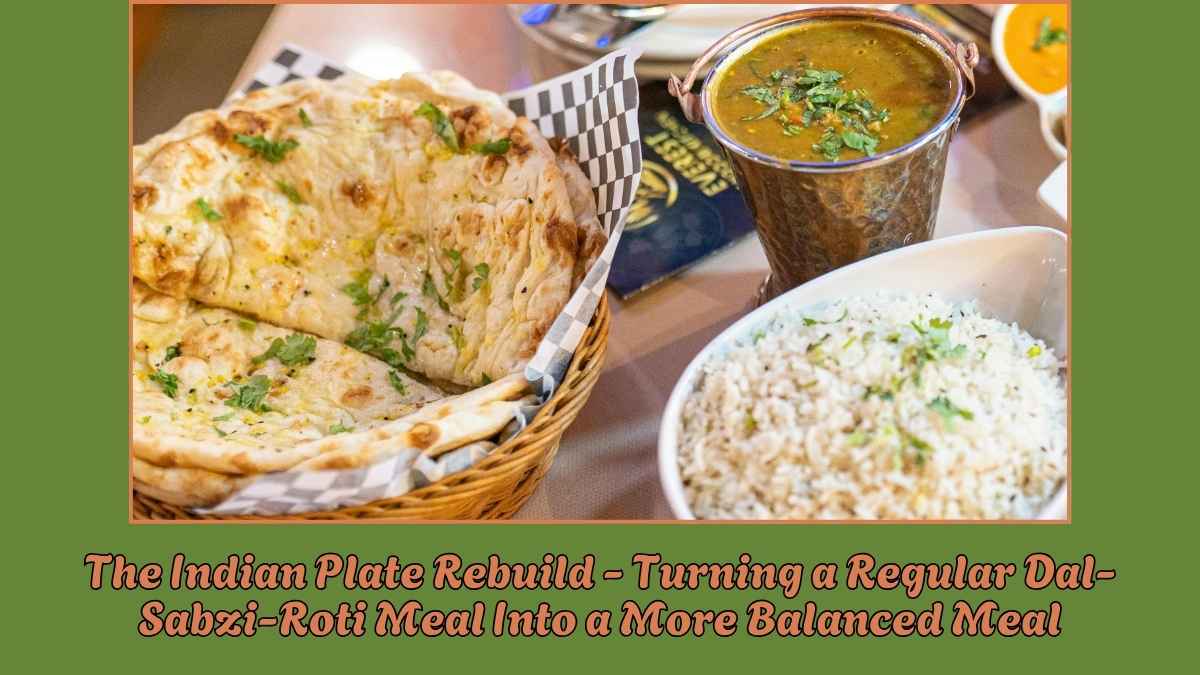
A plate of dal, sabzi and roti is one of the most predominant meals served in the Indian homes. It is affordable, re-modelable/can be scaled up to any other area, seasons and family requirements. Nevertheless, the meal has dal, sabzi and roti which may not necessarily be a balanced meal.
This variance is often taken to proportions.
A meal can also consist of three rotis, a little serving of dal and a few spoonfuls of vegetables. Another fact is that another person could eat a lot of rice, and little vegetables, with thin dal. It is not necessarily the foods that are the problem. The plate can be assembled in the following manner.
The plate rebuild indian would come in handy as well. Instead of replacing traditional foods, with more expensive health foods, salads or complicated recipes, you could reorganize the foods known to you to create a meal with a better balance of vegetables, foods and grains that are protein sources.
This principles guide is employed to recreate the simple dal-sabzi-roti meal in a manner that is convenient, comfortable and pleasant.
Balanced Indian Plate What It Means?
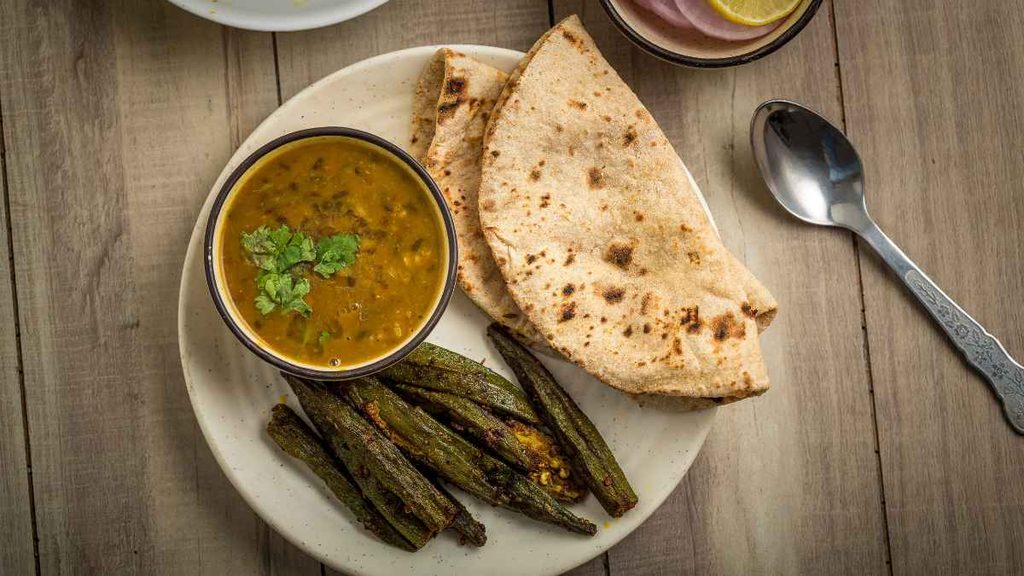
There is no single plate that is applicable to all. Different individuals have dissimilar food requirements founded on the age, level of activity, body size among other factors like health condition and status.
However, a rational balanced meal will normally comprise of different classes of food as opposed to the centralisation of a single food.
Being a common lunch or dinner among Indians, it could be a blend of:
- Roti, rice or any other grain.
- Dal, beans or any other food that is rich in proteins.
- Cooked vegetables
- Raw vegetables or salad as appropriate.
- Other capitalism or Curd.
- Fruit in the other of the meals.
It is not a concept to eliminate roti or rice. It is also to serve vegetables and protein rich foods with sufficient space on the plate as well.
Also MyPlate, the USDA guidelines, encourages the diversity of vegetables, grains, and protein food and fruits and dairy and fortified foods. It is also mindful of beans, peas and lentils as protein foods and therefore the framework can be easily modified to a variety of Indian vegetarian dishes.
Devising the reasons why a Regular Dal-Sabzi-Roti Meal could be unbalanced.
Dal-sabzi-roti is not tolesome as it is composed of various foods. In practice, however, the size of portions, and the mode of preparation, are of importance.
An Excess of the Plate Could be Roti or Rice.
Agricultural food is a typical occasion whereby the grain-size often forms the biggest part of an Indian meal.
The case in point is a man taking three or four giant rotis of a huge katori of dal and a dollop of sabzi.
Roti is not necessarily unhealthy. Nor is rice unhealthy per se. The issue is that in those instances when most of the food is consumed by grains, there may be a lack of space on vegetables and other foodstuffs.
Instead of merely adding a second roti as you feel hungry, remove the plate and say to yourself, is it possible to add to the plate more stock of dal or veggies, then add another roti?
The Vegetable Serving Can be too small.
Sabzi is even allowed to be technically present and make a bite or two on the entire meal.
Dietary fiber and significant nutrients could be found in vegetables. As explained in the USDA guidelines, vegetables can be a source of the following nutrients including potassium, dietary fibers, folate, vitamin A and vitamin C.
Complex salads are unnecessary to add more vegetables into the food. Eating vegetables that are eaten on a daily basis can contribute like lauki, bhindi, gobhi, beans, carrots, cabbage, spinach, tinda and pumpkin among many others.
Dal Could be served on a Side of Rye.
Dal rather should than lip-service.
Proteins: It may also be low fat, beans and peas are also potentially a source of protein. The USDA is aware of beans, peas and lentils being a part of their Protein Foods Group and considers them as a part of the Vegetable Group.
Dal can become an important addition to a daily meal of a vegetarian family, especially.
Rebuild Formula of Indian Plates
The practial rebuild does not require any consideration of all ingredients. Visualize in your mind the plate and make sure that one element is not dominating all the other elements.
The following framework is a simple one:
| Part of the Meal | Common Pattern | Balanced Rebuild Idea |
|---|---|---|
| Vegetables | Serving of sabzi. | Bring additional vegetables to the table. |
| Dal/beans | Few spoonfuls | Prepare a dish of dal, rajma, chana or any other pulse. |
| Roti/rice | Dominates the plate | Eat decently based on the need and appetite. |
| Raw vegetables | Often missing | Add carrot, tomato, radish or cucumber or choice. |
| Curd | Random addition | When it fits the meal, add plain curd. |
| Fat | Additional Ghee/butter automatically added. | Is specific and not uniform. |
| Pickle/chutney | Expensive price on flavour. | Maintain accompaniments that are heavily salted smaller. |
| Fruit | Replaced by sweets | Eat whole fruit other times of the day. |
It is a structure that is not prescriptive. The needs of individuals may vary.
Action 1: More Space to Sabzi
Adding more and more drinks on vegetables and their varieties is another easy change that is merely straightforward.
Where lunch would have had traditional two rotis, dal and two tablespoons of sabzi, observe how the sabzi might be a more salient part of the culinary.
Rotate Your Vegetables
Don’t fool on the same dayas potato-laden sabzi.
Rotate options:
- Palak
- Methi
- Bhindi
- Lauki
- Tori
- Cabbage
- Cauliflower
- Carrots
- Beans
- Pumpkin
- Capsicum
- Brinjal
Potatoes can still be part of home cooking. It is not a kind of vegetable which needs prohibiting but diversity.
Different vegetables contain different amounts of nutrients and this is among the factors that promote dietary recommendations of different vegetables.
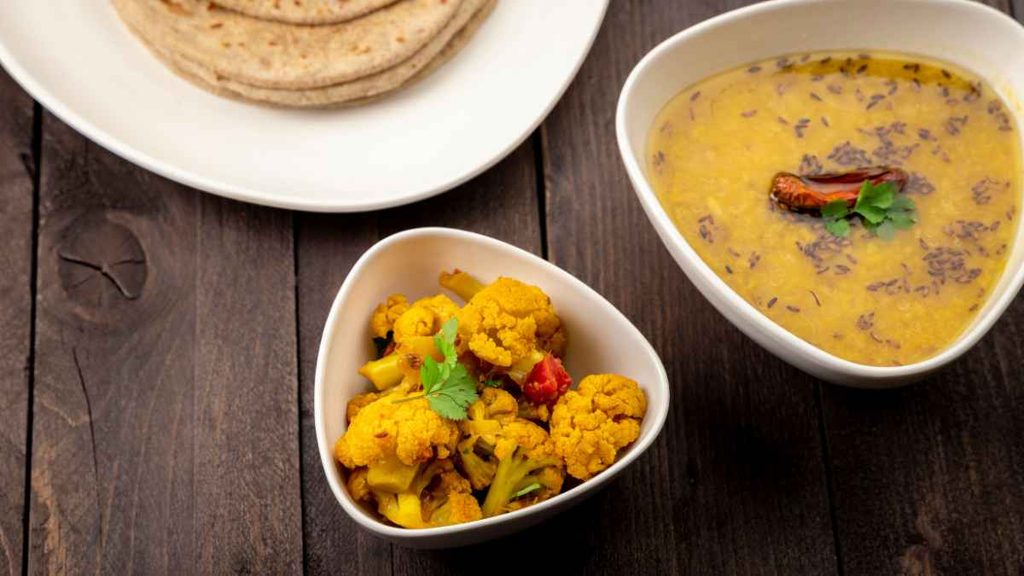
Step 2: Dal to a Real: Make Dal part of the Meal.
In such cases where dal is a major ingredient of the Indian meal, it is much easier to have a balanced Indian meal.
There are many moong, masoor, arhar, urad and chana dal. Chickpeas and lobia, rajma, can be consumed all week long, and kala chana.
Don’t Credit Ada There A Day.
The current diversity of pulses in the Indian kitchen already is outstanding.
Try rotating them.
For example:
- Monday: moong dal
- Tuesday: rajma
- Wednesday: masoor dal
- Thursday: kala chana
- Friday: arhar dal
- Saturday: lobia
- Sunday: chole
This transforms flavour and texture besides making your weekly meals more varied.
Depending on the other composition of the diet, other sources of protein that might be incorporated in vegetarian meals are curd, paneer, tofu, soy foods, nuts or seeds.
Step 3: Retained Roti, Redid the Amount.
The balance plate does not entail disposing of roti.
The roti provides the grains, and, in much of India, is all-day food. Rather than posing the question, “Should I eat less roti? a better question would be, How much sense does roti have with the rest of this meal?
Repackage the dish when you normally eat mainly roti with barely any of other foods.
To take an example you might find that instead of the four rotis of a little sail of dal and sabzi, a half portion of grain will do quite well combined with a half portion of vegetables and dal.
Also the right amount of roti varies with individual differences, therefore, no particular number of roti is normal.
Consider Whole-Grain Choices
Whole-wheat atta is already common in Indian homes and whole-grain is not so difficult to whole-roti drinkers.
There are always other types of grains which can be put in to add some flavour where they may fit you, your digestion and cooking style such as jowar, bajra and ragi.
Discrimination towards half of grain choices as entire grains is encouraged in the USDA MyPlate materials.
Step 4: Incorporate some Simple Fresh Component.
The balanced meal does not necessarily require as a fancy restaurant type of a salad.
One may add freshness and texture by a couple of readily attained vegetables.
Try:
- Cucumber
- Carrot
- Tomato
- Radish
- Onion
- Beetroot
- Lemon
- Fresh coriander
These also can be adjusted as per season and availability.
Unless your taste is used to raw vegetables, make sure that you eat more or more cooked vegetables instead.
Step 5: See past Ingredients into Cooking Method.
Nutritional variation is a difference that can be observed between two plates of exactly the same ingredients but are prepared differently.
Dehydrated not a floating vegetable dish cooked fish is a medium cooked dish. So basic tadka prepared on dal is not so much like dal with lots of butter or cream.
You need not get rid of oil or conventional tadka.
Instead, keep an eye out on additions which can be constructed without commotion such as:
- Oil
- Ghee
- Butter
- Cream
- Sugar
- Salt
- Fried toppings
Eat them in a mindful manner, rather than believing that one can always eat more to impart more flavour to the food.
Step 6: Stratefy with Curd
Cured curd is also a good complement to the majority of Indian dishes.
Dal, roti, seasonal sabzi, cucumber and plain curd, e.g., make a meal with several food categories without necessarily having to follow a special recipe.
Curd is not obligatory to all meals and even the people, who do not drink dairy products, can choose the suitable analogs of this drink, in their nutrition.
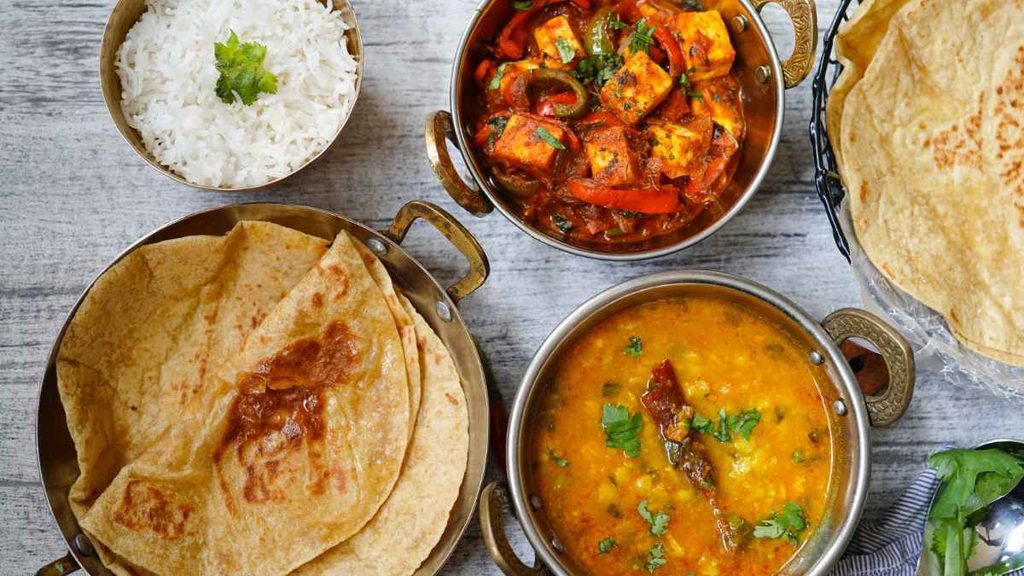
Three typical Indian Dishes: Reproduction.
Example 1: Roti-Based Lunch
Before:
34 rotis (little potato sabzi) + pickle.
Rebuilt:
An apt amount of roti + abundant mixed vegetable sabzi + dal + cucumber and carotts + plain curd.
There is nothing exotic that has been introduced. The percentages and diversity have merely varied.
Example 2: Dal-Rice Meal
Before:
Heavy dish of white rice + little bit of thin dal + pickle.
Rebuilt:
Foods: Rice Food but in moderate portion + dal in increased portion + cooked vegetables of the season + cucumber or fresh vegetable.
Rice is included in the food. it only breaks off consuming about half the plate.
Example 3: Rajma-Chawal
Rajma-chawal need not be scrapped off in a wholesome diet.
Replacing the large amount of rice on top of a small rajma gravy, make rajma to be a main dish, and vegetables to be a side.
The food is the same, taking pleasure in rajma-chawal.
Cost-effective methods of preparing an Indian Plate
Healthy eating is at times packaged as necessitating imported grains, protein powders, packaged foods and costly ingredients.
Archetypal Indian kitchen is of good variety of building blocks.
Different meals can be based on Dal, vegetables in-season, atta, rice, chana, rajma, lobia, curd and local available fruits.
Veggies are a great aid in particular since you can just switch the dish annually without having to alter your entire cooking habit drastically.
The most realistic meal program is typically the type that a family can afford, prepare and eat on a regular basis.
The Simplities to fallingly get into when attempting to make an effort at healthifying Indian food
One of such mistakes is to turn everything inside out.
One may be stunned and rice (rote), roti, potatoes, oil and traditional food may be deprived and replaced with food that they are not even fond of. This type of strategy can be difficult to maintain.
Another mistake is that, there is thinking that one ingredient can be the one that renders the difference between having a complete meal that is healthy or not.
The balance is due to the general pattern of eating.
The third error is not paying attention to portions. Even the nutritious foodstuffs ought to be part of the meal.
Finally, do not believe homemade to be balanced. Even home-cooked food can contain insufficient or excess amounts of vegetable variety or added fat, salt or sugar.
You are to have a Chore to perform on your next Dal-Sabzi-Roti season.
Before consumption, see the entire plate.
Ask yourself:
- Do I have somebody good serving of vegetables?
- Do I possess a good source of protein like dal, beans or other appropriate food?
- Does the meal contain roti/rice or virtually the entire meal?
- Will you have a straightforward fresh vegetable or suitable side?
You need not count all the grams.
The concept is to give a boost to the contents of the meals that you are already consuming.
The USDA MyPlate Vegetable Group guide will provide more general advice on vegetables, portions, and variety of food-groups. It is a governmental resource official on the nutrition in the U.S.
Conclusion
Indian cuisine does not require choosing between dal, sabzi, roti or rice to come up with a more balanced Indian meal.
In reality, these home foods can also be a rather apt foundation.
The big savings are of proportions: vegetables must be more prominent, a good portion (at least half) of dal or any other source of protein must be taken, the grains in a sensible proportion, a variety should be made in the course of the week, and care should be taken with regard to the rest of oil, butter, cream, sugar and salt.
Experiment with a single meal instead of restructure your whole diet.
Next time you use dal-sabzi-roti analysis the plate and then, look at the initially placed roti and then force another roti. What the meal actually might need is arguably another spoon of dal, some sabzi or cucumber on the side.
In cases where there is a plate already known to a person, any kind of small adjustments is generally far simpler to make than being forced to substitute the already known food.
Frequently Asked Questions
Is dal-sabzi-roti a balanced meal?
It can be. Dal will serve as a source of good vegetarian protein, sabzi will serve vegetables and roti will serve the grains. Balance is however, also an aspect of portions, vegetable variation, cooking styles and the rest of your diet.
How many rotis should I eat in a balanced meal?
There is no single number that is appropriate for everyone. Requirements depend on factors including age, body size, activity and overall diet. Instead of following a universal roti limit, consider the complete meal and make sure vegetables and protein-rich foods are not crowded out by the grain portion.
Do I need to stop eating rice to make my Indian diet healthier?
No. Rice can be included in a balanced diet. Rather than automatically removing it, consider portion size and what accompanies it. Combining rice with dal or beans and a substantial vegetable serving can create a more varied meal.